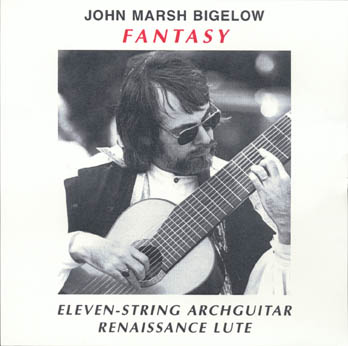
"FANTASY" John Bigelow, Soloist: (CD/Cassettes) All-Instrumental recordings of duet and solo pieces for Eleven-string classical guitar, Renaissance lute, small harp of Bach, Dowland, deMilano, O'Carolan, and contemporary works.
RENAISSANCE LUTE (tracks 1-9)
ELEVEN - STRING ARCHGUITAR (tracks.10 - 24)
SMALL HARP (trarck 25)
All arrangements/adaptations by Bigelow except where noted- * indicates double tracking
1- "The Fairy Round", Anthony Holborne (Renaissance Lute) to hear a sample
- click for MP3 file 108 KB size low resolution here
- click for MP3 file 1.1 MB size high resolution here
This lute piece is an eruption of Elizabethan exuberance that is sheer fun to play. Holborne's music is full of bouncy accents and syncopations derived from his combination of 3/4 and 6/8 time signatures.
2 - "Duo", Enrique Valderrabano (solo lute)
This piece for solo vihuela, played on lute here, is Valderrabano's intabulation of a brief but beautiful setting from an anonymous mass of a "pleni sunt caeli" in the Phrygian mode in two part counterpoint- hence the title "Duo".
3 - Fantasia, Francesco da Milano (lute)
The Italian, Francesco da Milano, was one of the first superstars in music, a predecessor to the stadium guitar heroes of today. This piece has everything one could want in a Renaissance fantasy; multivoice textures in imitation, incisive homophony, rocketing scales- all worked out through Francesco's unerring contrapuntal sense.
4 - "Meskin Es Hu", Jacob Obrecht (Lute and organ duet- Lorraine Saltre, Organ)
Obrecht was born in Bergen op Zoom, a biographical factoid I mention because its fun to say. Aside from that he was one of the masters of the 15th century Flemish school of counterpoint which, sadly, is now not well known other than to specialists and scholars. The title is a folk song which Obrecht used as a basis for this short three part exposition which we have distributed between lute and organ.
5 - Pavan, Luis Milan (lute)
Milano's Spanish contemporary, Luis Milan, was a master of the vihuela, a guitar type instrument the usage of which was comparable to that of the lute elsewhere in Europe. The bulk of his 1536 publication El Maestro consists of forty fantasias, also included, among other things, are six pavans which are mostly really small- scale fantasias. Though much the societal courtier, in this second of his pavans, Milan musically comes near to evoking the religious intensity of a mass movement by Palestrina or Victoria, whose musical language Milan speaks through his instrument.
6 - Fantasia, Francesco da Milano (lute)
It is possible I may have played this piece more often than any other in my repertoire; it offers such excellent return in performance satisfaction for the technical investment of playing it. Instead of beginning as Milano so often does with a singly stated theme as a basis for subsequent imitations, he commences with the combination of a simple song-like descending line with a supporting bouncy countersubject underneath. This compound texture then weaves its way through a two and three partnered dance to one of Milano's typically satisfying plagal cadences.
7 - "Greensleeves", trad. arr.: Bigelow / Francis Cutting (lute)
My own sedate setting of this Renaissance classic is a slightly elaborated and harmonically varied version of the oft anthologized anonymous Elizabethan setting; as is often done, I have sandwiched in between this and its reprise the famous upbeat variation by Francis Cutting.
Greensleeves - Traditional (guitar) to hear a sample
- click for MP3 file 160 KB size low resolution here
- click for MP3 file 2.0 MB size high resolution here
8 - Fantasia / * Recercate Concertate, F. da Milano/J. Matelart (lute solo and duet)
One of Milano's simpler but engaging fantasias, with its interesting call and response imitations, is followed by a duet version with a second lute part added by the Flemish lutenist, Joanne Matelart. Following the forward-moving solo fantasia with the duet, slowed in pace to accomodate Matelart's amplifying commentary, is like following a fulfillingly active afternoon with an evening's pleasantly driftt
9 - "Toy", Francis Cutting (lute)
There are many small scale Elizabethan lute pieces which, in spite of titles contrived to connote their having been tossed off in a moment of idle whimsy, like "puff", "toy", or even "nothing", are yet pieces well worth playing, as is this example from Francis Cutting. Great fun.
10 - Fantasy, John Dowland (11-string guitar)
At the other end of the spectrum from pieces like Cutting's "Toy", the fantasies of John Dowland are serious music indeed, even when ebullient in nature, and are representative of the Renaissance lutenist's art at its highest manifestation . This one encapsulates in a single piece a presaging in form and texture the pairing of prelude and fugue characteristic of the Baroque period which followed Dowland's era. Not as long as others of his fantasies, it is large scale more by virtue of the startling distance travelled by Dowland in an economy of measures than by sheer length, an aspect of his musical thought wonderfully characterized by a colleague of mine as "like sheet lightning". This performance was recorded on eleven-string guitar instead of lute.
11 - Prelude, Sylvius Leopold Weiss (11-string guitar)
Weiss was not the absolute last, but was the greatest of the last exponents of the lute, which ended its long and distinguished history in Baroque Germany (dates). No more the elegantly simple instrument that the Renaissance lute was by comparison, the Baroque lute had evolved into a magnificent but imposing instrument with thirteen or more double strings (two strings on one course); these courses no longer tuned predominantly in fourths but disposed through what today would be called an "open" d minor, with extra basses offset to one side of the neck. Next to one of these my eleven string guitar, on which I have set this prelude, would suddenly seem ordinary! Weiss' prelude here, with its chain of resolving suspensions, is similar in character to some of the arpeggiated preludes of his friend and colleague J.S. Bach, who also wrote for this Baroque instrument.
12 - Allemande, (First Lute Suite), Johann Sebastian Bach
13 - Bourree, (First Lute Suite), J. S. Bach (11-string guitar)
These two contrasting dances, the Allemande with its background contrapuntal motions lifting out of a lacy texture of arpeggios and connective linear phrases , and the Bourree. more direct and overt in its rigid two-step of bass and treble, are among the most accessible of all the movements from Bachs four suites for Baroque lute. The Bourree, (meaning "little steps of the burro") if not the "little" prelude in d minor, may be the piece by Bach most frequently learned and performed by guitarists.
14 - Gavottes (Sixth Cello Suite), J.S. Bach (11-string guitar)
Bach is usually thought of as a purely abstract composer but this pair of Gavottes seem deliberately contrived to conjure up images of rustic peasant revelry, especially in the second one with its evocation of a grinding hurdy-gurdy drone accompaniment. My transcription of these from the four strings of the cello to the eleven strings of my classical guitar places them in the key of D rather than E as is the usual treatment on six string.
15 - "Jesu, Joy of Man's Desiring", J.S. Bach (11-string guitar)
Bach's famous and favorite chorale setting for chorus and orchestra from his 147th Cantata may well be his work most availed of by the general community of instrumentalists and ensembles for transcription or rearrangement. In my transcription for 11-string guitar, I have averted the confusion between choral and orchestral lines which would result from the undifferentiated timbre of a singular instrument if they were to be combined into the same octave as in the original, by relegating the tune and accompaniment alternately to different octaves during the first two statements of the choral theme. This establishes a precedent whereby the conjoining of the two, in the same octave, is clarified and understandable in the continuation, and, thus, is a truer rendering of Bach's writing than would occur by merely dropping the orchestral accompaniment during statments of the choral theme, as is often done.
Especially in regard to transcription to a singular medium, be it piano, guitar, harp, hammered dulcimer, even solo violin or cello, etc., the frequency of this access is carried on in spite of, in rendering a whole or complete arrangement, the problems presented involving sufficient acknowledgement of inner voicings, and adequate registration of the distinction between elements which the ear finds easily separable from each other in the original orchestration. Flatly stated, this chorale, written for chorus and orchestra, does not lend itself as gratefully to such transcription as do pieces made to travel less distance in the conversion of medium; that this is nevertheless so often done in spite of that obstacle simply underscores how well loved it is- everyone wants to play this piece, and will find a ready and receptive audience for it when they do.
It is inevitable that in order for a result to lie easily within perceived parameters of the natural character of an instrument to which a transcription is made, that there is a plethora of "transcriptions" of the Jesu which in all honesty do not attempt more than to present excized and fragmented portions of what Bach wrote. Alternatively, the philosophy behind more ambitious transcriptions is to arrive at something which benefits from one's impressions being informed, as one is listening, by thoughts of the original, not necessarily to be plausible throughout as wholly endemic to the instrument without exceeding in concept its character.
in either case, that such transcriptions are partially dependent in their merit on this reference back in homage to the original, in addition to the opportunity they provide for presentiment of an instrument's and performer's capabilities does not detract from the worthiness of the exercize or the aesthetic validity of the results; the success of many such transcriptions is a testament to the durability of Bach's musical conception.
Among the transcriptional challenges alluded to above, is that in his original setting, the simple chorale melody, when introduced by the chorus into the pre-established instrumental texture, steps forward and identifies itself plainly as the thematic basis of the orchestral obbligato filagree by which it is preceded and in which it is embedded. it is easy to distinguish the vocal and instrumental parts from each other as they intertwine through the same register. This can become confusing when in transcription these separate parts are jointly rendered into one singular instrumental quality so that the ear loses track of what each part is doing. In transcription the chorale tune is therefore sometimes simply left to stand alone at these points. In my transcription, rather than casting aside and foregoing the obbligato during statements of the chorale theme, I have relegated the tune and accompaniment alternately to different octaves during the first two statements. This establishes a precedent whereby the conjoining of the two in the same octave is clarified in the continuation.
Jesu, Joy of Man's Desiring, J.S. Bach (11-string guitar) to hear a sample
- click for MP3 file 624 KB size low resolution here
- click for MP3 file 2.0 MB size high resolution here
16 - Minuet I-Sarabande-Minuet II-Minuet I, Anon. / Falkenhagen (11-string guitar)
The first of these two minuets and the sarabande are both anonymous, likely by the same composer. The second minuet is the top half of a lute duet by the Germanic Baroque lutenist Adam Falkenhagen. The accompanying half of the duet being dispensible, I have transposed the top part to the key of the other two pieces, munched them all up together and voila!- a nice da capo Baroque piece to play. Strictly speaking the tempo is a bit brisk for the forms, especially for a sarabande, but adhering to the same tempo throughout preserves the continuity of this newly grafted-together "piece".
17 - Etude, Op.35,#22, Fernando Sor (11-string guitar)
Hailed as "the Beethoven of guitar", but more resembling Haydn or Boccherini in his works, Sor takes a Chopinesque turn in this much beloved B minor etude. Simple yet engaging, like a melancholy nocturne, this piece is among the first of those learned by many guitarists, yet it has a staying power for which it tends to remain in one's active repertoire long after one has moved on to more challenging works.
18 - * Duet in G, Ferdinando Carulli (guitar duet)
Carull pursued his career mostly in Paris during the early 19th century as a performer and a prolific composer for guitar. Aside from student pieces many of his lasting contributions to the guitar repertoire have been in ensemble music, including many guitar duets. In these, the second guitar part usually does play a decidedly supporting role, but rather than relegating it only to the most rudimentary of accompaniments as in some of his contemporaries' works, Carulli allows it to share much of the interest, both in contributing equivalently with the first part to the overall texture and in occasional solo forays, as in this modest example.
19 - " Recuerdos de la Alhambra", Francisco Tarrega (six string guitar)
The texture in which long note values of a melody are rendered as their sum equivalent in a stream of reiterated 32nd or 64th notes is called tremolo, as is the right hand technique used for producing the effect. I doubt if there is any guitarist who does not think first of this piece, no matter which they may actually favor, when tremolo is mentioned, either in the context of likely studies for learning the technique or as concert worthy repertoire in which the texture figures prominently. It is a composition well deserving of the continuous attention it has received whereby it has attained to the status of a "warhorse" of the repertoire; that there are those whose reaction to this status is to dismiss it, does not seem to have dissuaded either the legions who are motivated particularly by this piece to learn the technique or the concert virtuosi who still record and perform it in concert, let alone the public who receives it with such affection. The title means "memories..." or "recollections of the Alhambra", which is usually thought of to be in reference to the Alhambra palace in Granada, a pinnacle achievement in Moorish architecture, for the beauty of which there is a saying, that there could be no worse fate than to be blind in Granada. There have been recent claims that Tarrega's recollections in fact were of a theater by that name in connection with an affair that he had had. Interesting- but who knows for sure? Whatever were Tarrega's own ideas, to those not party to the affair, the languid melodic pace and the murmuring tremolo certainly are fittingly evocative of the Alhambra palace's fountains, and water running under the walkways to keep them cool in the hot afternoon sun; the long rise and fall of the melodic gestures paralleled in thirds below, along with the inexorable regularity of the harmonic support, appropriately recall the ornate moorish arches and columns. That I am moved to write so of a place which I have not been fortunate enough to have visited in person, bespeaks the power of its impression even if conveyed secondarily, and of the reinforcement to the image delivered by what is likely Tarrega's most famous composition. This is one of the earliest recordings on this collection, done in a recording studio near Amsterdam during my first trip to Europe with my wife. You can hear the occasional receding "swish" of the digital delay the engineer used in lieu of true digital reverb, a technology not as prevalently available then as it is now.
20 - "Desafinado", Antonio Carlos Jobim (11-string guitar)
I hope it isn't- the title means "a little out of tune". This song was among those recorded on the first seminal albums which brought to the attention of the American public, the conjoining by this composer and his contemporaries of Brazilian samba and jazz into the new form of Bossa Nova, a popular jazz idiom perhaps more than any other inextricably linked with guitar as a generating source of inspiration.
21 - Danza ( from "Preludio y danza"), Julian Orbon (six string guitar)
This recording is the earliest of this collection; unfortunately the section of tape with the "preludio" is not available. I nevertheless could not resist including this "Danza", not only because of the piece's own appeal, with its spicy dissonances and jagged accents, but also because it exudes an optimistic Cuban vitality which I fondly recall as so characteristic of the composer himself. My wife and I were most fortunate to have formed a friendship with him when I discovered, after having learned the piece, that he was well acquainted with older members of my family. He subsequently was instrumental in our securing an engagement to perform at the Spanish Institute in New York City, for which concert I programmed this piece, and on several of our trips to New York, we were privileged to spend afternoons with him during which, to illustrate his conversational points in discussions of music history, he was wont to leap to the piano, which he played with the same wild verve he imbued into this composition.
22 - "Lamentation of the Angular Beast", James Rufus Hartman (11-string guitar)
I am also acquainted with the composer of this piece, in this case as a contemporary from my school days and a dear friend, though he has since relocated to a different locale and we all too rarely correspond. At one time in our lives we worked together as nightwatchmen at the Gardner Museum in Boston, where we were jointly acquainted with the director's small highland terrier, named Angus. Occasionally during the night the director, from his residential quarters on the top floor, would send Angus down in the elevator to where was located our watch station, where we would tease him some with bits of our lunch before allowing them to him. He resembled more than anything else a rolled up bit of dirty gray shag carpet, at one end of which could be discerned with difficulty his obscured but amiable canine countenenance; he used to twitch and snuffle his way right next to us in a most annoying fashion through his post-prandial somnolance, and he had as his paramour a half-inflated basketball to which, much like the story of Heloise and Abelard (which is in keeping with the Medieval provenence of much of the museum's exhibit) , he remained true and loyal, even through their enforced separation, and in spite of his having been surgically deprived of the capability of bestowing upon it his fully competent attentions. We affectionately referred to him as the Angular Beast.
My friend Jim heard on the radio one day a performance on an instrument which he once told me made him think of a strung up garbage can; being an accomplished musician with a taste for eccentrica, he immediately became emamoured of the instrument and had to have one. It turned out to be an instrument competitively marketed by a couple of different companies early in the twentieth century; you would have either a "pianolin" or "ukelin", depending on which company's salesman came first to your door. The instrument featured metal strings, some of which were plucked to provide a bass and chordal accompaniment, while the melodic strings were individually played by a bow, which was guided to the appropriate string by skipping around in an awkward fashion to points between small adjacently situated croquet hoops, which delivered the bow to one end- extreme end- of the sounding length of the string- hence the aluminated sound.
With regard to the intersection of these two referred to above, separate accountings arose when poor Angus met his demise through the agency of an unanticipated encounter with a truck during a midnight stroll. There is, in the Scottish fiddle tradition, a venerable pratice of writing memorial pieces for distinguished personages who have passed on, much like Baroque Tombeaux or "Tomb" pieces. These were Lamentations, usually entitled "the Lamentation 'of' ...", rather than "...for...", whomever was the esteemed departed citizen.
In deference to Angus' Scottish heritage, and having previously secured and actually learned to play his pianolin, or ukelin, Jim felt that it befell to him the responsibility of writing, for that instrument, Angus' Lamentation; the nobly conceived and ably executed result is what, with almost no necessitated transcriptional adjustment, I am honored to present here on eleven-string guitar. Jim had thought his labours were being extended at least partly in jest as he was writing this, but the subconscious will have its way- upon hearing this recording pf my slower interpretation, he said that he had had no idea that he had written such a profound piece.
23 - * "O'Carolan's Concerto" Turloch O'Carolan (duet with double speed guitar)
24 - "Christmas Day idda Mornin'" / "O'Carolan's Receipt for Drinking" Trad. Scottish/ T. O'Carolan (11-string guitar)
25 - "Planxty Sir George Brabizon", Turloch O'Carolan (small harp)
Except for the Shetland tune "Christmas Day idda Mornin' " which I have affixed in medley to the second of the last three pieces simply because I like it that way, these are O'Carolan tunes written for harp- the last, in fact, being the only tune which I have ever learned and recorded on that instrument, the others presented here in my arrangements for eleven-string guitar.
The harp was so inextricably associated with independent Irish culture that the English, during periods of excessive occupational repression prior to O'Carolan's, felt compelled to outlaw its use; many were the harpers hanged simply for pursuing their profession. They were accused of carryng messages through their music and journeys as spies to the rebels. The tradition was nevertheless stubbornly adhered to and proved durable enough to last until and beyond Turloch O'Carolan's lifetime, which was more or less equitably distributed to either side of the turn of the 18th century. He is today the best known figure from that centuries long tradition, in spite of the fact that he was very much his own man and not the most stylistically pure representative of that tradition. Though operating in a cultural stream which had been marginalized by the rest of the western society, he was aware of and influenced by the musical practices of the continent, whereby he was able to meet the Italian composer Geminiani and impress him with his extemporization of "O'Carolans's Concerto" recorded here.
O'Carolan's music was notated only as a single melodic line; I have taken the liberty of assuming the role of Matelart to O'Carolan's Milano (see notes to "Fantasia / Recercate Concertate" above) and have written a second part which though accompanying in nature is contrapuntally equivalent. This accompaniment is heard as guitar in the recording; O'Carolan's original melody was recorded on guitar at half tempo, which recording was then was played back at double speed for accompanying, which brought the tempo back to the intended lively pace while raising the pitch up an octave. The resulting mandolin like sound seems appropriate to the Italianate construction of O'Carolan's line.
His "Receipt...", which is used as segue from the Shetland Christmas tune, is a piece occasioned when a doctor, as a palliative for the depression into which O'Carolan had plunged as a result of another physician having proscribed against his further consumption of alcohol, wrote him out a prescription (or "receipt") that he should hie himself to the pub and hoist a few. This authoritative and medical sanctioning of his lifting some spirits lifted his own spirits to the point that he was able to compose this testament to his renewed gaiety. It is entirely coincidental that I have conjoined it with a piece which makes a different sort of spiritual reference.
According to what I've read, O'Carolan was the only composer to write pieces called "planxtys", and that it is a term cofounded both on the Latin planxtum, a conjugation of plangere, meaning to strike making a metallic or plaintive sound, and the Irish word planncaim, meaning to "strike", as in "striking a harp". The form of entitlement is always "Planxty- (someone's name)", the name probably of a patron of O'Carolan's. Since "planxty" essentially means to "play (the harp)", I like then to think that these may be the first character-portraits in music, as such titles might be interpreted to mean " 'playing' Sir George Brabizon," to use the example recorded here, or "playing" Sir Festus Burke," or Charles Coote, or whomever was the dedicatee.
Planxty Sir George Brabizon, Turloch O'Carolan (small harp) to hear a sample